February reading
Coetzee on tour

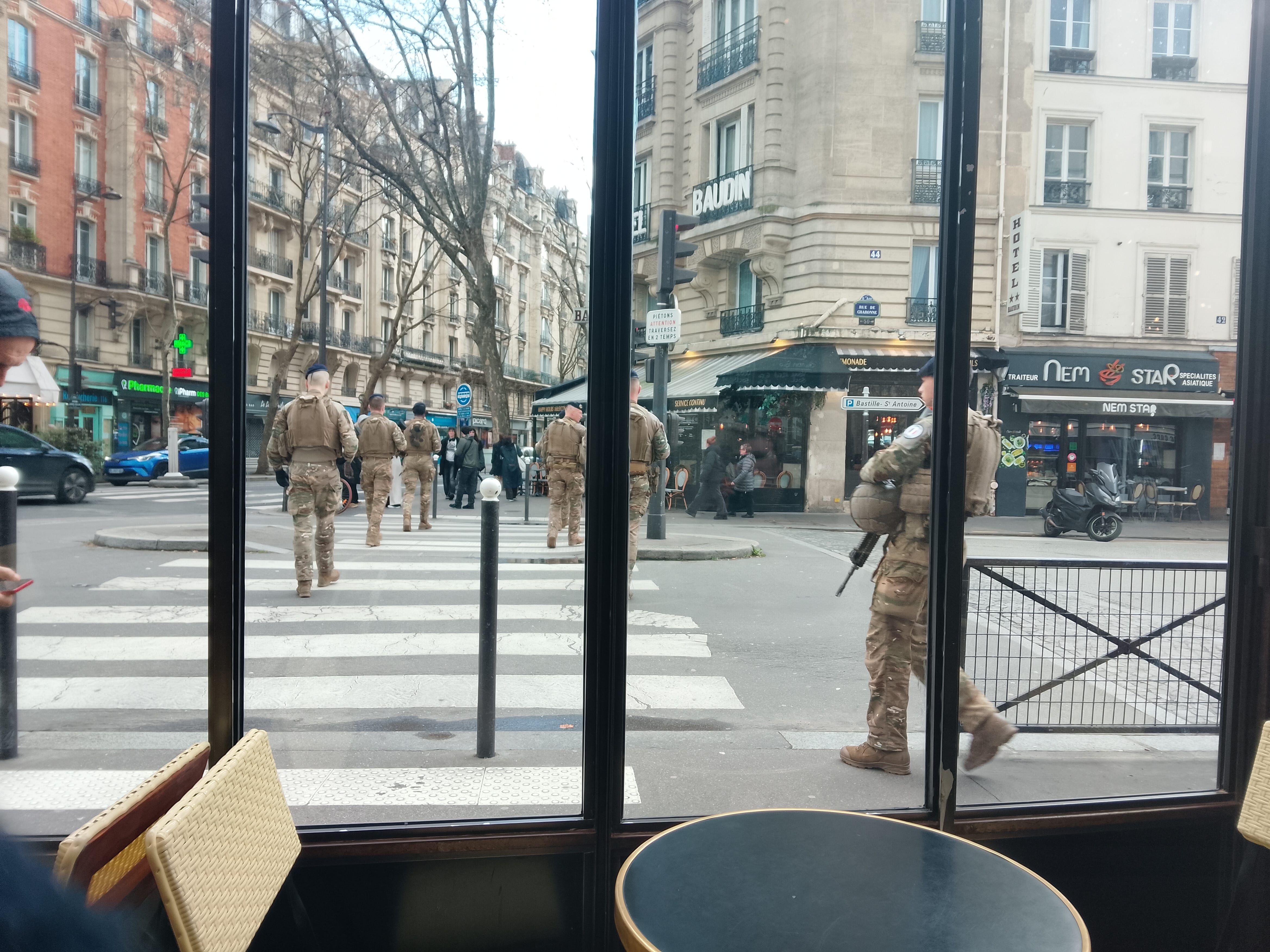
Packing light for Paris meant I forewent all my hefty book plans (Bleak House OUSTED) and was instead saddled with my new, cheap plastic laptop for a reading device. Nothing will make you read faster than wanting to get off a plastic screen—highly recc’d as a speed-reading tip. This was how I ripped through J.M. Coetzee’s Waiting for the Barbarians, not just because of the screen but because its simple narrative arc (establishing normal then disrupting with conflict) somehow hit me as if it were the most revolutionary structure known to man. I think I only just realised that this arc is age-old for a reason—it’s almost like it has something to teach us…! Isn’t it the exact narrative arc we are all scared of right now? That the end of history was wrong and now the chaos of Real Life is asserting itself...? The novel has clearly always tried to remind us of this. Outside the Centreville bistro where I read, French police with giant machine guns casually patrolled the pavement which served as an apt accompaniment.
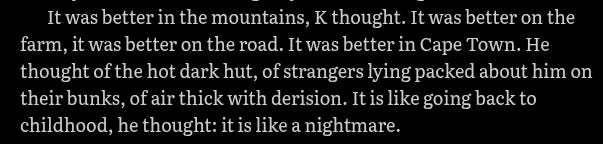
I decided Coetzee may be the best writer for my temperament (so far, I’ve not read a book of his I dislike) so next was The Life and Times of Michael K. I read this back to back with Waiting For the Barbarians so things got a little blurred. They are thematically indistinct: moral proximity, caretaking, a bleak reality getting even bleaker. I can’t imagine this being written by anyone who didn’t grow up in an apocalyptic state aka apartheid. It’s clear Coetzee has spent the rest of his life processing it. K’s ultimate fear is returning to his childhood. I could cry! It’s so real and so effortless.
I was reading this just before meeting Food Art Sex Books at Cité des arts’ open studios in Montmartre, an artist’s commune which can only be described as utopia. A nice palate cleanse to reading about the horrors. Spent the rest of my trip blissfully without phone access, on a diet of cheese, 3 euro wine and coke zero—it was truly The Life and Times of K Feenstra.
Read Matthew Gasda’s new novel Stranger Beauty in the 11th which was freezing and inevitably beautiful. Everyone on the terrace was a hot gen z parent and blew cigarette smoke into their toddler’s faces. The peak form of The (British?) Novel is always domestic conflict coloured with anxiety about emerging technologies. In Stranger Beauty, AI acts as Jethro Tull’s seed drill would in 1701—a force looming over the central couple whose lives are staked on the pointed end of an AI-soaked world. Meaning feels beyond their grasp, not because of AI but because of the truth of being alive. It’s a straightforward novel in that way, and a reminder that novels are the best medium to talk about technology.
The second half of the book slips into a play—my arch nemesis. I recently edited a screenplay and found it truly excruciating. No matter how good a script, I never enjoy reading it because it’s an act of translation but without the joys of a second language. My brain gets exhausted. I can’t appreciate Arcadia because I’m traumatised by doing years of drama school where, if a piece of dialogue is set beside a stage direction, it immediately takes on a stilted quality. That same dialogue in direct speech within a novel wouldn’t bother me at all.
Speaking of mise en abyme, I am currently at a writing residency in Switzerland and picked up Hari Kunzru’s Red Pill, which is itself about a writer at a writing residency. Turns out Kunzru was at the same one as me, though this ominous novel luckily preceded that visit, inspired by his time in Berlin. As pets begin to resemble their owners, I wonder if writer husbands begin to sound like their writer wives—he and Katie Kitamura’s sentence structures are weirdly similar. I know this because I always pay extra attention to sentences that restate the same thing in different clauses (it is a big bad habit of mine). This book was fine. The kind of novel retrofitted for some essay already written. Lots of the musings are sandwiched in. The culmination of conflict at the end was a replica of the conflict throughout the whole book. But its a humbling reminder that good writers can write mid novels and how scarily easy it is to get a novel wrong…
I gave up on Sarah Water’s Tipping the Velvet, not because it was bad (it’s very clearly a great book) but I needed something moodier. For once in my life I didn’t want to read a romp!
Have just begun Kiran Desai’s The Inheritance of Loss and it’s already obvious to me I’m going to become obsessed. On the audio book front, I’ve been micro-dosing Virginia Giuffre’s memoir which is predictably horrific and Deborah Feldman’s Unorthodox which is quite brilliant. I was making headway with N.K. Jemisin’s The Fifth Season, but it was too classy and well-written to listen to any longer. With audio books I just want pure content—good form confuses the sonic experience…